HOTMA Implementation Requirements for HUD Assisted Housing
Owners must execute three separate income and asset rule changes by January 1, 2027.

HOTMA became law on July 29, 2016, amending Sections 3, 8, and 16 of the United States Housing Act of 1937. Its final rule did not publish until February 14, 2023 (88 FR 9600), effective January 1, 2024. The law itself has not changed since. What has changed, four separate times, is HUD's own compliance calendar, and that gap between a settled rule and an unsettled rollout is the actual story here. Owners who keep waiting for a fifth extension are reading the pattern backward: every delay so far has come from HUD's paperwork and software, not from any new doubt about the policy, and nothing in the record suggests that changes for January 1, 2027.
Title I of HOTMA runs fourteen sections, touching public housing and Section 8 alike, and HUD's stated goals were never controversial: standardize income counting across programs, simplify determinations for tenants, and let families build savings without losing assistance. Nobody in the industry seriously argues with those goals. The argument, to the extent there is one, is over the eight years it took to get from statute to enforceable rule, and the additional three years (and counting) it's taken to get from enforceable rule to working software. That second gap is the one owners need to plan around now.
The three substantive rule changes owners and PHAs have to execute
Three separate workstreams make up HOTMA's operational core, and none of them collapses into the others. If owners treat this as one policy switch to flip, pieces of it will get missed.
Section 102 rewrites income counting. The new rule is simpler than the old one: count all amounts received by adult household members, plus unearned income belonging to anyone under 18, unless a specific exclusion applies. The imputed asset income threshold jumps from $5,000 to $50,000. Households below that line can self-certify their assets instead of owners chasing third-party verification, a real cut in file processing paperwork. VA aid and attendance benefits are excluded from income entirely now, though other VA disability payments still count, an inconsistency owners will have to explain to tenants more than once. Foster adults and foster children drop out of the household count for income and asset purposes but still count toward unit size and utility allowances, so those two counts now diverge in a way they never used to.
The Earned Income Disregard ended for new enrollments as of December 31, 2023, with current participants phased out over time. Reexamination methodology splits in two: initial occupancy and interim reexaminations now run on a forward-looking 12-month income estimate based on current circumstances, while annual reexaminations still look backward at the prior 12 months unless a streamlined determination applies. Interim reexaminations also get a new trigger, activated any time adjusted income drops by 10% or more, or by a lower threshold if HUD or the PHA sets one.
Section 104 puts a hard asset ceiling into the program for the first time in its history. Applicants and participants holding assets above $100,000 (adjusted for inflation annually) are ineligible, and owning a home the family has a legal right to live in triggers ineligibility regardless of its paper value. PHAs and Section 8 PBRA owners still keep real discretion here: Attachment A of Notice H 2023-10 spells out circumstances where the asset limit doesn't have to be enforced, and that discretion has to get written down, not assumed. The rule also redefines net family assets and now requires owners to obtain authorization before pulling financial records, a procedural step plenty of files still don't reflect.
Then there are the deduction changes, smaller in scope but real in dollar terms. The dependent deduction moves from $480 to $500 for owners adopting HOTMA in calendar year 2026, and the elderly and disabled deduction moves from $400 to $550. Owners should have a process in place to track the current year's applicable figures.
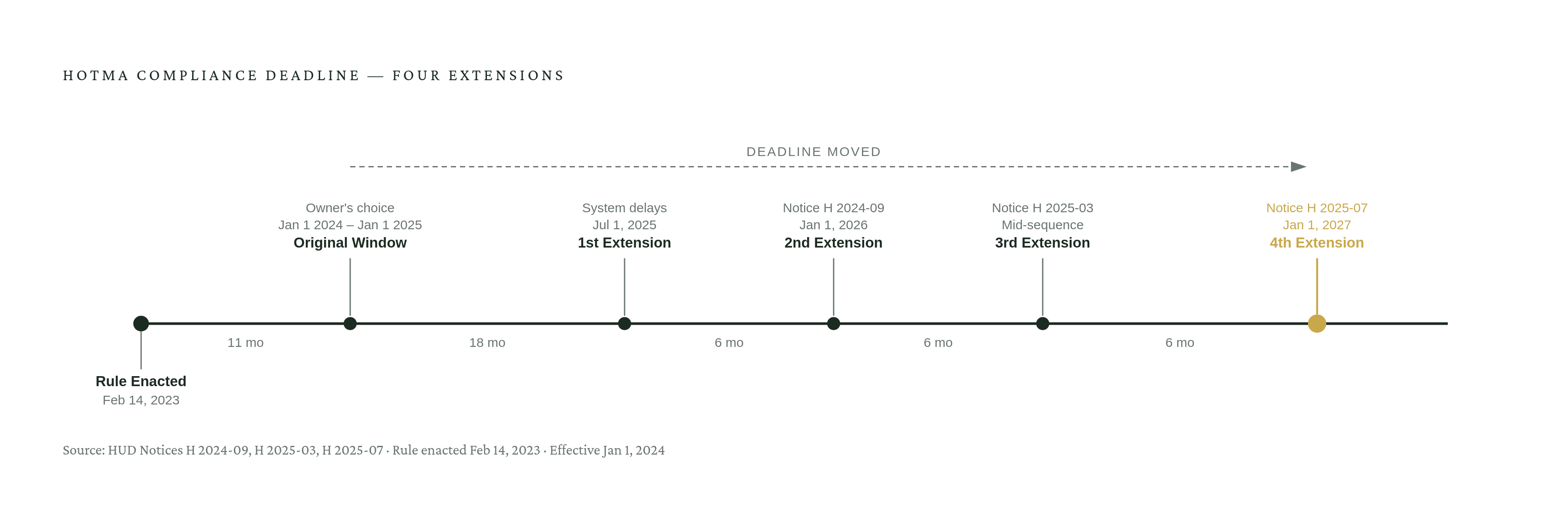
How the compliance deadline moved four times
Each extension supersedes the last, and reading them in isolation misses the pattern entirely: HUD's rule stayed fixed while HUD's own implementation timeline kept sliding underneath it.
The original compliance window let PHAs and multifamily owners pick their own date, anywhere between January 1, 2024 and January 1, 2025, with voluntary early adoption allowed from that point on. The first extension pushed multifamily owners out to July 1, 2025, and HUD's stated reason was delay in updating its own internal systems, not any substantive problem with the rule itself. That extension applied to multifamily only; PHAs stayed on a separate track the entire time.
The second extension moved multifamily further out, to January 1, 2026, superseding the notice before it (Notice H 2024-09). At one point in this sequence, The pace of notice issuance made clear how unsettled the process had gotten even inside the agency writing the rule. Notice H 2025-03 runs all of seven sentences. A rule this consequential, extended by a document that short, tells you where the real bottleneck sits.
The date that governs multifamily owners right now, the fourth move, is January 1, 2027, set by Notice H 2025-07. That's the fourth move. Bet on it holding, because HUD has now had three prior deadlines fail for the same reason (unfinished systems), and the systems work is visibly, if slowly, catching up.
Where each program type stands as of late 2026
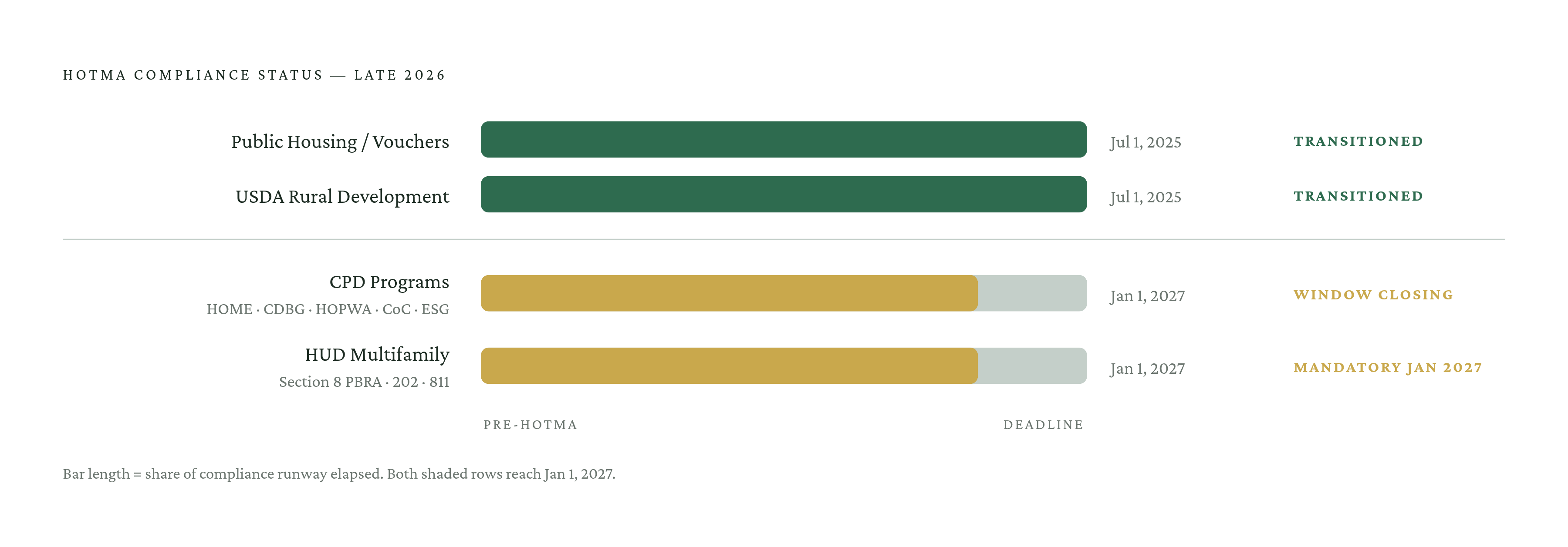
The programs under HOTMA's umbrella are not on the same clock, and treating them as one program is the most common mistake owners make right now.
HUD Multifamily (Section 8 PBRA, Section 202, Section 811) still operates under pre-HOTMA rules through the end of 2026, with mandatory compliance landing January 1, 2027. Early adoption is available now through the TRACS 202D rent override function.
Public housing authorities and voucher programs already moved on July 1, 2025, under Notice PIH 2024-38, though full compliance still waits on HUD's own IT modernization timeline. Updated definitions in 24 CFR 5.100, 5.403, and 5.603 apply to any transaction on or after that July 2025 date. For PHAs, the transition period is over. The job now is consistent application across every file, not preparation for something still coming.
USDA Rural Development adopted HOTMA on July 1, 2025, with its own implementation timeline separate from HUD Multifamily. Owners under USDA RD programs who haven't caught up should treat their implementation window as closed.
CPD programs (HOME, CDBG, HOPWA, the Housing Trust Fund, ESG, Continuum of Care, HOME-ARP) had a window that opened as early as January 1, 2024, with a late-end deadline of January 1, 2027. Grantees who haven't begun compliance work have little runway left.
Why HUD's systems and forms, not the rule itself, have driven every delay
Every one of the four deadline extensions traces back to the same cause. HUD's own paperwork and software weren't ready, and in some cases still aren't.
As of mid-2025, multifamily owners still didn't have updated HUD Model Leases reflecting the new interim reexamination rules and asset limitation policies. Form HUD-50059, which owners use to certify tenant eligibility and income, hadn't been updated to capture the data fields HOTMA now requires, and neither had HUD-50059A, HUD-9887, HUD-9887A, or HUD-9834. TRACS, the certification transmission system owners rely on to run these calculations, is still on version 202D. TRACS 203A, the version actually built to handle HOTMA calculations natively, hasn't shipped.
That gap between rule and infrastructure is the whole story. In July 2025, HUD published a Federal Register notice seeking public comment on the updated HOTMA-related forms, so the process was still sitting in stakeholder feedback, nowhere near final. HUD also made updated draft forms available through the HUD Drafting Table, but owners planning around January 2027 are, in effect, planning around software HUD is still building in public. Owners planning around January 2027 are, in effect, planning around software HUD is still building in public, in real time, with the public able to watch the drafts change.
What multifamily owners should be doing between now and January 1, 2027
Operating under pre-HOTMA rules stays fully compliant through December 31, 2026. Treating that as permission to wait until then is the mistake. Owners who read the deadline that way are going to be scrambling in the fourth quarter of 2026, and by then the deadline won't move a fifth time to bail them out.
Start with the paperwork that's already overdue. The Tenant Selection Plan has to reflect HOTMA's discretionary policies, and the deadline for updating both the TSP and the EIV Policies and Procedures was already pushed once, from March 31, 2024 to May 31, 2024, under Notice H 2024-04. Owners who haven't touched these documents are behind on a deliverable that came due over two years ago, not one that's approaching. The asset limit enforcement policy needs the same treatment: Attachment A of Notice H 2023-10 lays out when owners can decline to enforce the $100,000 ceiling, but that decision has to be made and written down, not left as an assumption sitting in someone's head. LeadingAge has published a checklist aimed at mission-driven owners working through exactly that decision.
Owners can adopt HOTMA now using the TRACS 202D rent override function combined with manual file annotation. Owners can adopt HOTMA now using the TRACS 202D rent override function combined with manual file annotation. The tradeoff is plain: early adopters get real operational experience with the new reexamination triggers and asset rules before the deadline forces the issue, but they carry the manual annotation burden until TRACS 203A actually ships. Larger portfolios with staff time to spare should lean toward adopting early. Smaller shops running lean may reasonably decide the manual workaround costs more than it's worth right now, and wait for 203A to do the work automatically.
Staff training is the last piece, and it isn't the place to cut corners. HUD has published training videos on the implementation overview, net family assets, and income determination, all through the HUD.gov Multifamily HOTMA page. HUD Exchange runs HOTMA Office Hours with live Q&A for PHAs, and for multifamily-specific questions, HUD's contact point is MFH_HOTMA@hud.gov. None of these resources fix the unfinished forms or the missing TRACS release. What they do is separate the owner who understands the rule cold by January 2027 from the one still guessing at how the new interim triggers apply on an actual file, on an actual reexamination date, with an actual tenant standing in the office.