Available Unit Rule and Next Available Unit Rule in LIHTC
How tax credit projects preserve affordability when tenant incomes rise above program limits.

The Low-Income Housing Tax Credit program has a math problem built into its design: every unit that stops counting as "low-income" shrinks the applicable fraction, and a smaller applicable fraction means a smaller credit. IRC §42 solves this through two related mechanisms, the Available Unit Rule and the Next Available Unit Rule, both of which exist to keep a building's credit intact when a tenant's income rises above program limits without forcing that tenant out the door. Owners who don't understand how these rules trigger, and what they demand operationally, can lose credit eligibility on units that did nothing wrong except house a resident whose paycheck got bigger.
What makes a unit "over-income"
LIHTC was never built to punish a tenant for earning more money. Once a household qualifies at move-in, it stays eligible for as long as it lives there, regardless of what happens to its income afterward. That's a deliberate policy choice, not an oversight: the program wants stability for the residents it houses, not a treadmill where a raise or a new job puts someone's housing at risk.
What does trigger a compliance event is a specific numeric threshold, not a slow slide. For most projects, that's the 20-50 or 40-60 minimum set-aside election, and the threshold is 140% of the applicable income limit for the household's size. Deep rent-skewed projects electing the 15-40 structure under IRC §142(d)(4)(B) get a higher ceiling, 170% of the applicable limit, in exchange for setting aside at least 15% of units for households at or below 40% of area median income. Serve the poorest tenants, and the program gives you more room before a rising income becomes a problem.
These thresholds live in IRC §42(g)(2)(D) and get fleshed out in Treasury Regulation §1.42-15. These thresholds live in IRC §42(g)(2)(D) and get fleshed out in Treasury Regulation §1.42-15, and the term "over-income unit" refers only to a unit where a previously-qualified household's income has climbed past the threshold at recertification. It applies only to units that were previously qualified, not to a unit that was never qualified. That's a different problem entirely, and a different section of the code.
The Available Unit Rule: what IRC §42(g)(2)(D) requires
The Available Unit Rule is at IRC §42(g)(2)(D), with the operational detail worked out in Treasury Regulation §1.42-15, finalized effective September 26, 1997 under Treasury Decision 8732. An over-income unit stops counting as a low-income unit if any available unit in the same building, comparable in size or smaller, gets rented to a new tenant whose income exceeds the limit.
To keep the over-income unit in the applicable fraction, every next available unit of comparable or smaller size in that building has to go to a qualified low-income household. Not the next one. All of them, for as long as the over-income unit remains uncorrected in the fraction.
The word "available" carries real weight in Treasury Regulation §1.42-15(c). A unit stops being "available" for AUR purposes once it's no longer available for rent under a binding contractual arrangement recognized by local law, such as a signed reservation between the owner and a prospective tenant. That detail matters operationally: a reservation signed before a vacancy opens up can take a unit out of NAUR obligation entirely, which gives leasing staff a real lever to manage timing around an over-income event.
How the Next Available Unit Rule works for mixed-income and 100% affordable buildings
The Next Available Unit Rule is really just the working name for the same obligation described above, the day-to-day mechanics of complying with the Available Unit Rule. When a building has an over-income unit, the owner has to steer the next available unit or units of comparable or smaller size to a qualified low-income applicant.
In 100% affordable buildings, this is close to a non-issue. Every vacancy is a low-income vacancy by definition, since there's no market-rate pool to draw from, so the rule satisfies itself automatically. There's no extra leasing maneuver required, no operational burden layered on top of an over-income event.
Mixed-income buildings are where the rule actually bites. An owner running a property with both restricted and market-rate units has to identify every available unrestricted unit of comparable or smaller size and direct it to an income-qualified applicant instead of a market-rate one, and keep doing that until the applicable fraction can be met without relying on the over-income unit. Once that threshold is met, the over-income unit loses its low-income designation. The underlying logic is straightforward: a household stays qualified until its income crosses 140% of the set-aside's AMI threshold, and that's the moment NAUR obligation kicks in for a mixed-income building.
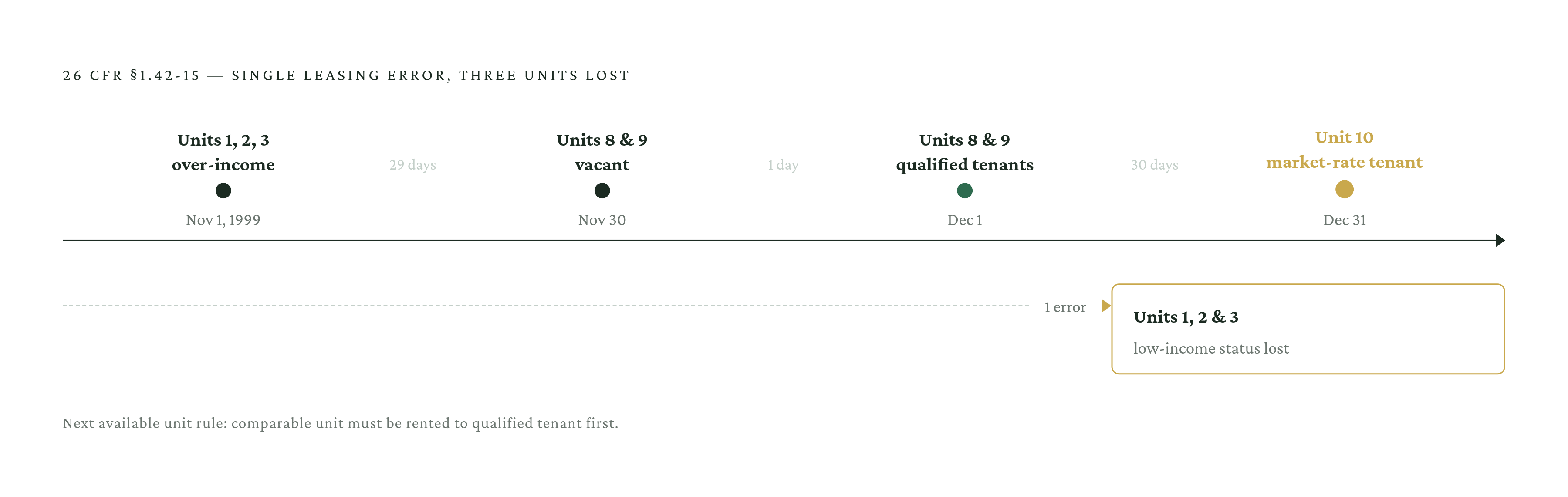
The regulatory example baked into 26 CFR §1.42-15 makes the stakes concrete. Units 1, 2, and 3 go over-income on November 1, 1999. Units 8 and 9 come vacant on November 30 and get leased to qualified tenants on December 1, good so far. But Unit 10, comparable in size and available, gets rented to a market-rate tenant on December 31. The result: Units 1, 2, and 3 all lose their low-income status, not just Unit 10. One misstep on one unit erases the protection for three others.
How the Average Income Test changes the AUR calculation
The Average Income Test, added as an alternative minimum set-aside election, lets owners designate units anywhere from 20% to 80% of AMI in 10-point increments, so long as the average across all designated units doesn't exceed 60% AMI. The applicable fraction still governs credit eligibility under AIT, but figuring out what counts as an "over-income" unit, and how NAUR restores the fraction, gets considerably more layered once units carry different designated income levels rather than one uniform limit.
The AUR still applies under AIT. What changes is the tracking burden: an owner has to confirm that the next available comparable unit is leased to a qualified household in a way that maintains the building's overall compliance under the AIT structure, not just to any income-qualified tenant. Lease a unit to a household that technically qualifies but pushes the average over the line, and the NAUR obligation isn't actually satisfied.
That cascading effect is the real distinction from a standard set-aside project. Under AIT, one over-income unit losing its designation doesn't just shrink the applicable fraction in isolation. The interconnected nature of the AIT calculation means a single over-income unit can have ripple effects across the building's overall compliance picture. The math is interconnected in a way a standard 20-50 or 40-60 project simply doesn't have to worry about.
Tenant protections and the eviction question the NAUR leaves open
Federal LIHTC rules never require an owner to evict an over-income tenant. The NAUR exists specifically so an owner can absorb a tenant's rising income without displacing anyone, by shifting compliance burden onto future vacancies rather than onto the household that's already there.
And because NAUR compliance lets the owner keep claiming credits without penalty, there's no financial incentive to evict, either. An over-income tenant, standing alone, creates no liability for the owner. Eviction in that scenario would be both legally unsupported by IRC §42 and economically pointless.
What federal law doesn't settle is whether over-income status counts as "good cause" for eviction under state landlord-tenant law. IRC §42 is silent on the question, which leaves it to state statutes and lease terms, and it remains a genuinely contested area of housing policy.
State variation shows how much is left open. California, for instance, keeps LIHTC properties rent- and income-restricted for 55 years, and its income requirements apply at the start of a tenancy rather than as an ongoing condition of lease renewal, with tenant protections that extend across the compliance period. A pending bill, California AB 2689, would let an owner decline to renew a lease when a tenant's household income exceeds 140% of AMI for two consecutive years and with a 90-day notice requirement before lease expiration. As of the most recent available information, its final status should be confirmed before anyone relies on it.
What noncompliance with the AUR costs an owner
AUR violations appear on IRS Form 8823, the document state housing finance agencies use to report noncompliance to the IRS. Owners get a 90-day window after noncompliance is identified to fix it before the agency is required to notify the IRS, and correcting the problem inside that window can keep the 8823 from ever being filed as uncorrected.
Missing that window causes the consequences to stack. The over-income units affected lose their low-income designation, which shrinks the applicable fraction and cuts the credit the building generates going forward. The IRS can require the owner to return already-claimed credits, with interest, a cash outflow that can hit operating reserves hard and fast. And the affected units generate no credit at all until the noncompliance gets fully corrected.
The AUR is genuinely dangerous for owners who treat it as a minor leasing detail because of its scale problem. Because one violation on one available comparable unit can knock multiple over-income units out of low-income status simultaneously, as the Unit 1, 2, 3, and 10 example shows, the financial exposure from a single leasing error has no fixed ceiling tied to the size of that error. A leasing agent renting the wrong unit to the wrong applicant on the wrong day can trigger a recapture event spanning several units, all traceable back to one available unit that should have gone to a qualified household and didn't.